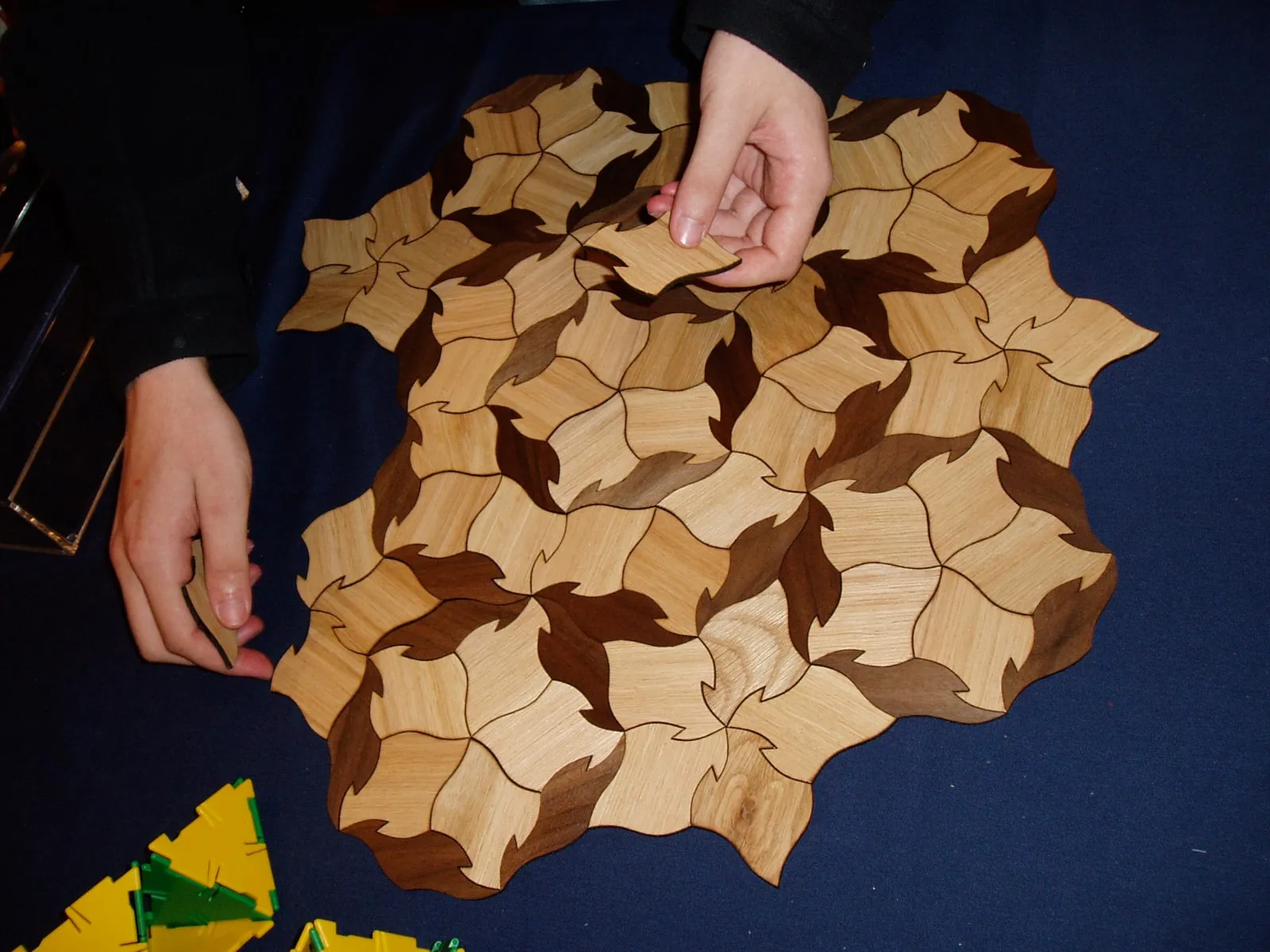
How do Shapes Fill Space?
Tilings and patterns at the Royal Society Summer Science Exhibition.
Patterns and tilings appear everywhere and are one of the oldest parts of mathematics. Have you ever wondered what you can learn by simply putting shapes together? Like the tiles on your bathroom wall or the hexagons of a honeycomb. In mathematics, shapes fitting together to fill a space are called tilings, and are the key to understanding much about how space can be organised. Despite a history going back to ancient Greece, there are still many unanswered questions in the study of tilings.
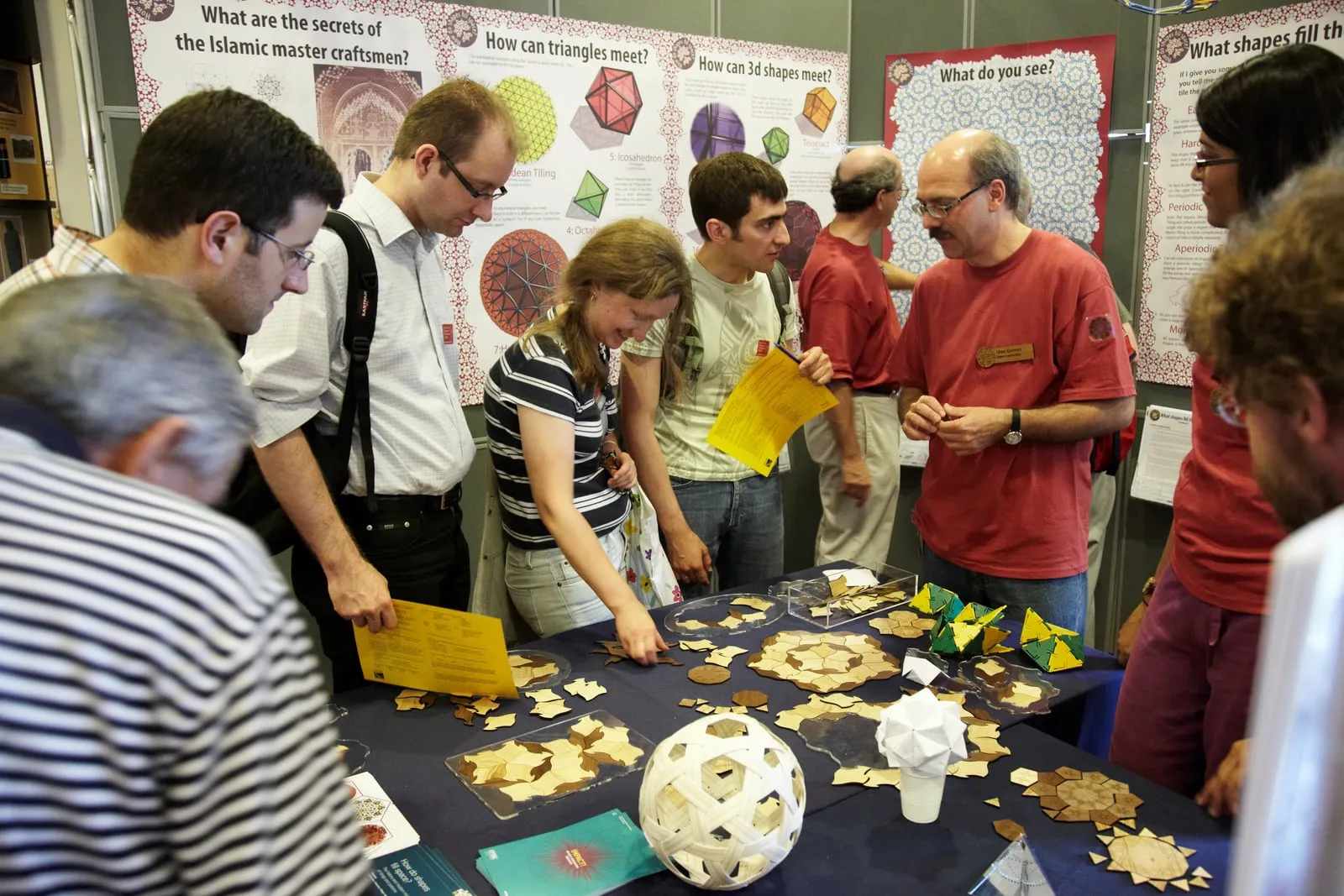
This exhibit was one of 21 competitively selected stands from more than 100 entries at the 2009 Royal Society Summer Science Exhibition. Visitors could explore tilings through laser-cut interactive toys, regular polygons, Penrose tiles, and puzzles, alongside seven themed poster stations taking them from Greek geometry to modern mathematical research.
The exhibition team
The exhibit was put forward by Edmund Harriss, who assembled the team:
- Edmund Harriss (Open University & Imperial College, London)
- Uwe Grimm (Open University, Milton Keynes)
- Richard Henry (Birkbeck College & British Museum, London)
- John Hunton (University of Leicester)
- Vinay Kathotia (Royal Institution, London)
- Jeroen Lamb (Imperial College, London)
Supported by EPSRC, Imperial College, University of Leicester, Open University, Royal Institution, Polydron, and Zometool.
The seven stations
The exhibition told two interweaving stories through seven poster stations, each accompanied by a factsheet.
Story 1: How can shapes tile the plane?
Starting with Greek geometry, just three regular polygons can tile the plane: the equilateral triangle, square, and regular hexagon. Relaxing to allow more than one shape gives the eleven Archimedean tilings. Then stepping back in history to the extraordinary tilings of the Islamic world, before arriving at Penrose’s remarkable discovery: a pair of tiles that fill the plane but never periodically.
Story 2: Can we tell whether shapes will tile the plane?
Wang’s conjecture and Berger’s proof that the tiling problem is undecidable, no algorithm can answer the question for every possible set of shapes. This leads to substitution rules, the projection method, and connections to quasicrystals.
And linking both stories: what happens when the angles at a corner don’t sum to exactly 360°? Less gives polyhedra; more gives hyperbolic geometry.
Posters and factsheets
All exhibition materials are available to download. The posters are large-format graphic panels; the factsheets are double-sided A4 handouts going into more mathematical depth.
| Station | Poster | Factsheet |
|---|---|---|
| 1. Where do we start? | Poster 1 | Factsheet 1 |
| 2. What are the secrets of the Islamic master craftsmen? | Poster 2 | Factsheet 2 |
| 3. How do triangles meet? | Poster 3 | Factsheet 3 |
| 4. How do 3d shapes meet? | Poster 4 | Factsheet 4 |
| 5. What do you see? | Poster 5 | Factsheet 5 |
| 6. What shapes fill the plane? | Poster 6 | Factsheet 6 |
| 7. New Maths, New Science! | Poster 7 | Factsheet 7 |
Download all: All posters (23 MB) · All factsheets (10 MB)