Art / Shows
Artworks
Generative images, prints, installations, and sculptures.
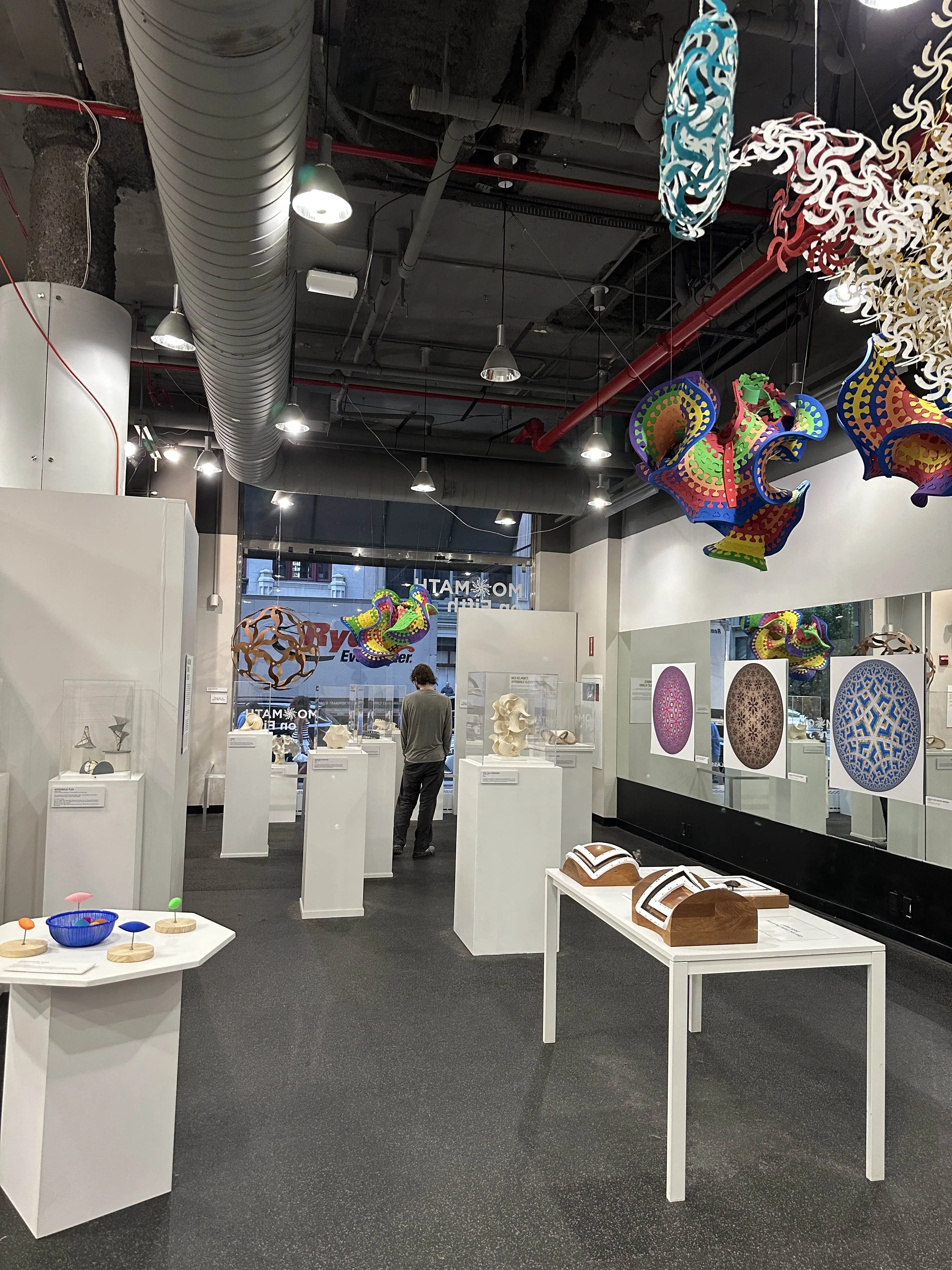
Holonomy Blocks
A large-scale interactive exhibit for the Museum of Mathematics (MoMath), New York, made with Henry Segerman. Three CNC-carved wooden surfaces — a sphere (positive curvature), a flat plane (zero curvature), and a pseudosphere (negative curvature) — each carry a metal rook that slides along rails carved into the surface. Moving the rook around a right-angled polygon and returning to the start, visitors discover that the rook has rotated: the angle of rotation is the holonomy, directly encoding the total curvature enclosed. The same rook design works on all three surfaces, making the comparison immediate.
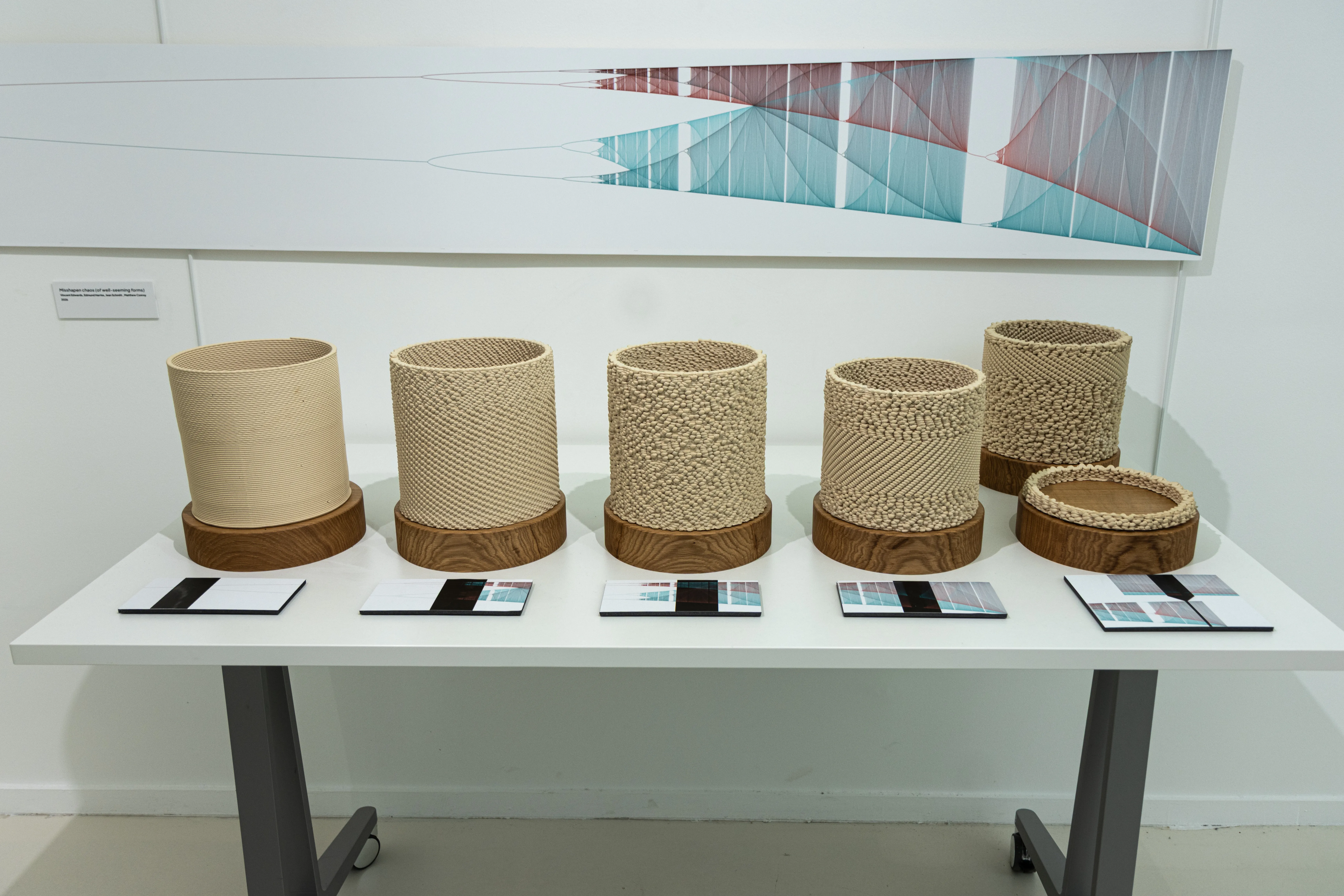
Misshapen Chaos: of Well Seeming Forms
A series of six clay 3D-printed vessels on walnut bases, each encoding a different parameter of the logistic map as the equations are transformed into machine toolpaths for the printer. The surface of each vessel — from regular coiled rows at the base to chaotic bumps at the rim — traces the period-doubling cascade as the map bifurcates toward chaos. Created with Vincent Edwards and Jean Schmidt. Exhibited at Bridges 2025 (Eindhoven) and at the Création: Between Art and Mathematics exhibition at the Institut Henri Poincaré, Paris (April 2026).
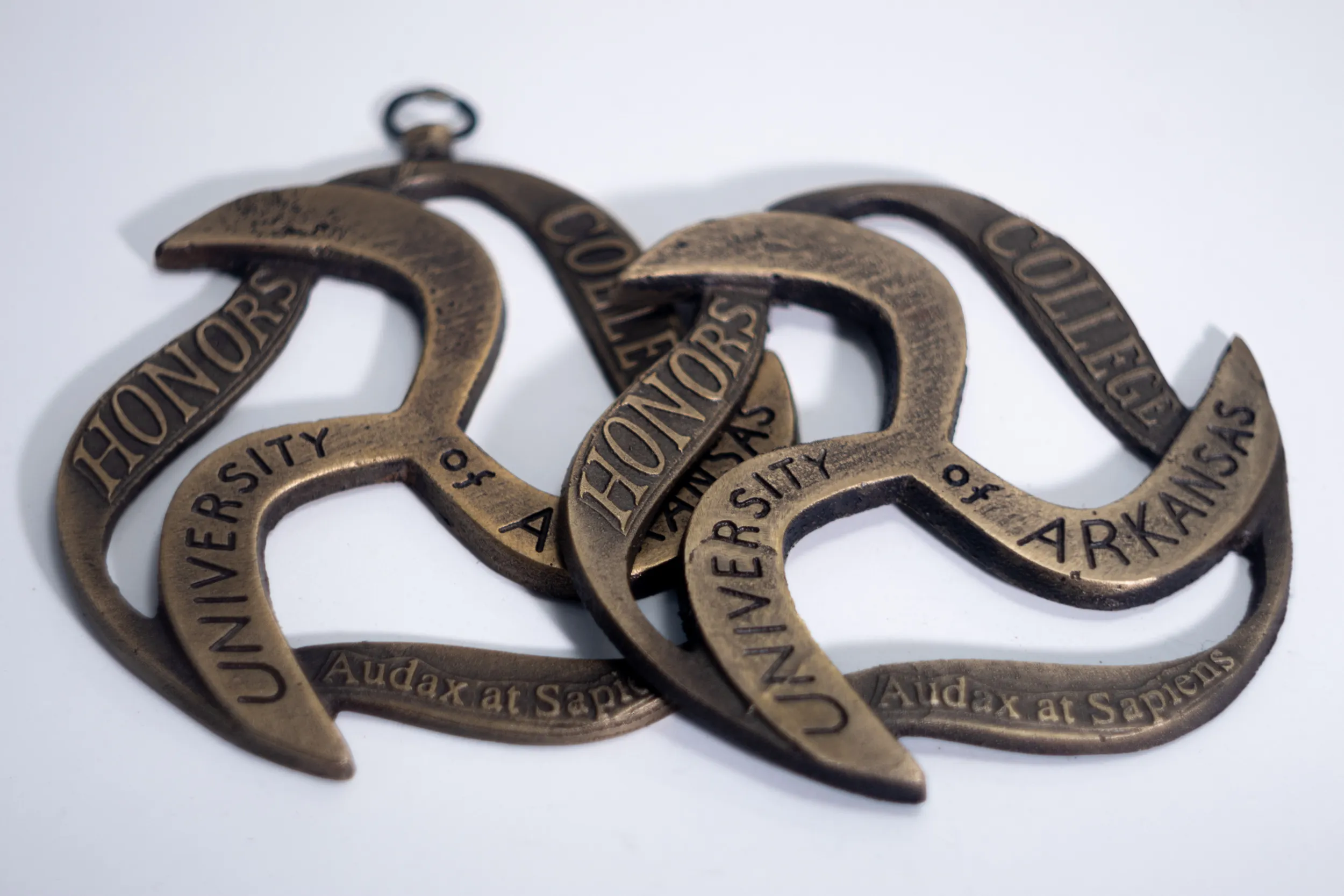
Curvahedra Medal
A medal created with Eugene Sargent for the University of Arkansas Honors College's Distinguished Faculty Award in 2024/
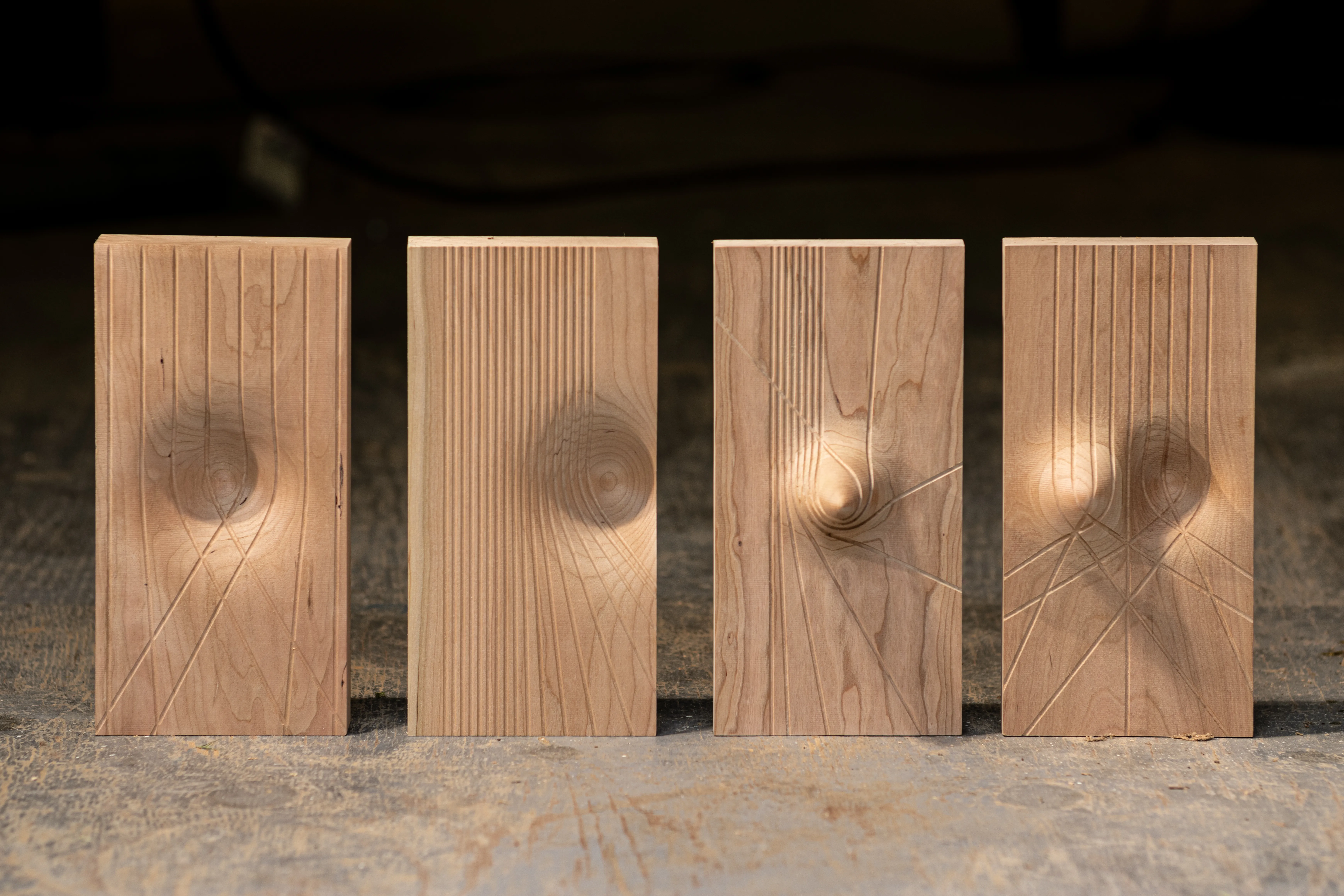
Geodesic Boards
A set of CNC-carved wooden boards that make geodesic curves on mathematical surfaces tangible and touchable. Joint work with Steve Trettel
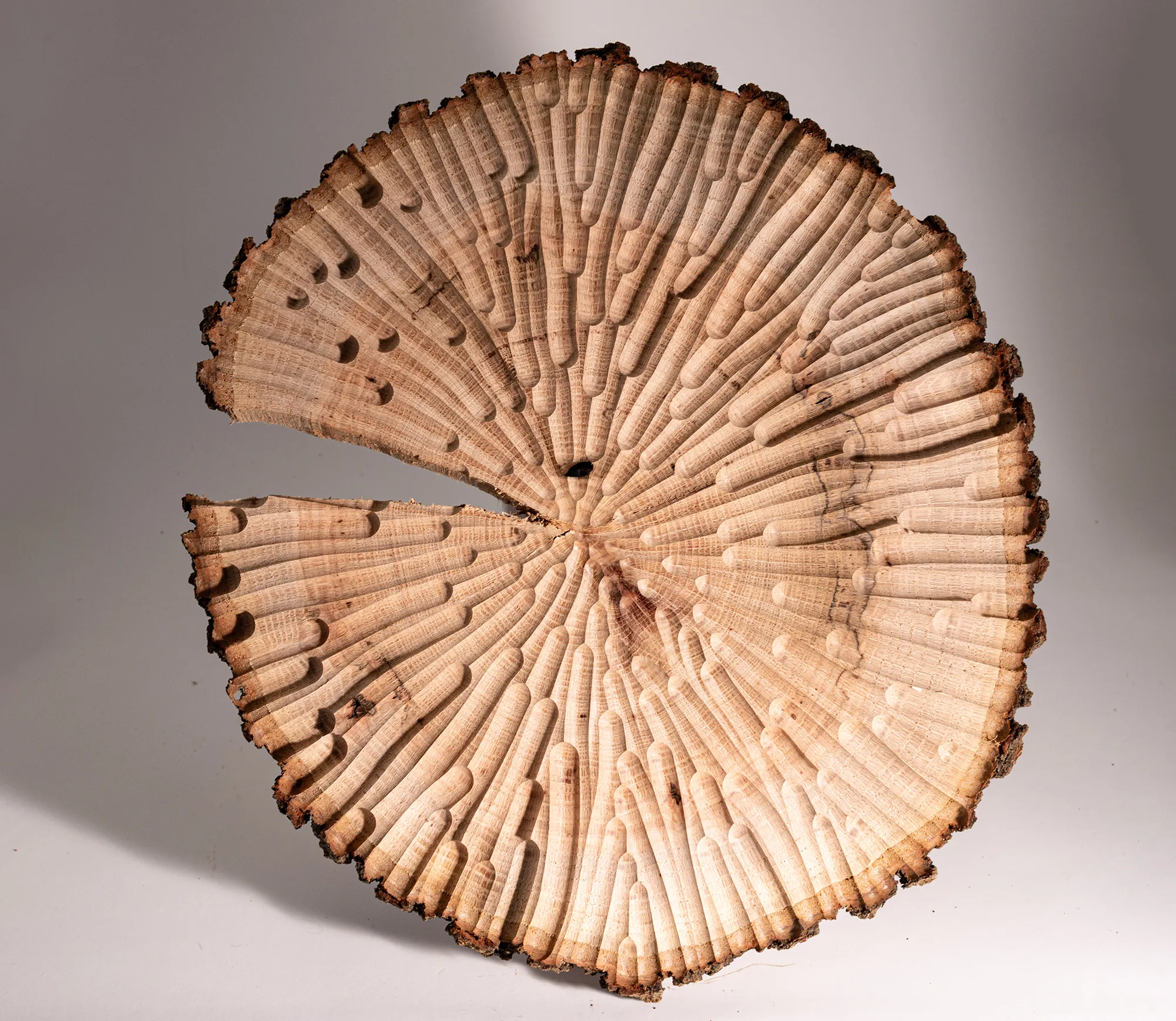
Gradient of Grain
Carving gradient paths into the grain of a piece of wood. Featured in the New York Times (October 2025).
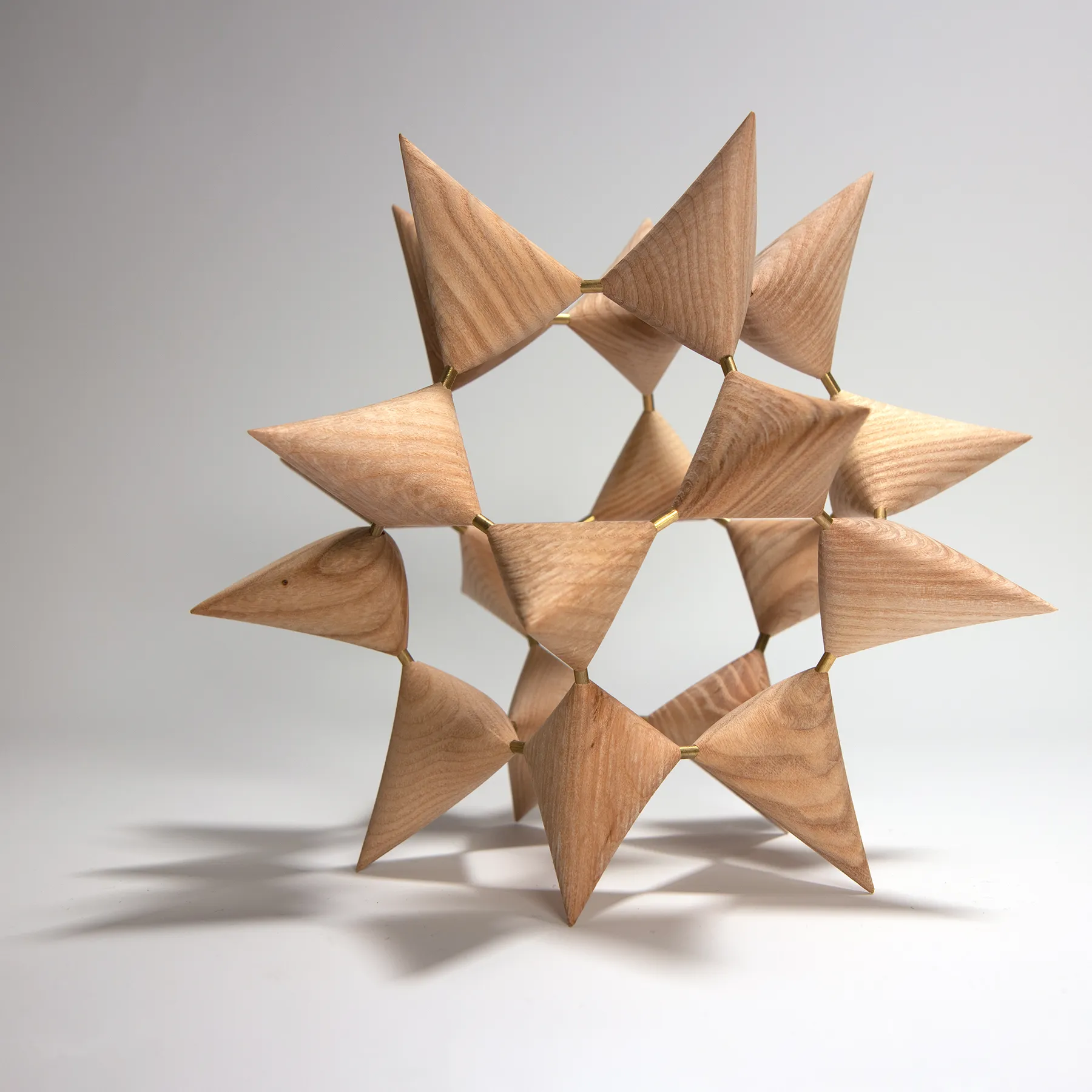
Barth Sextic
A physical sculpture of the Barth Sextic — an algebraic surface of degree six with the maximum possible number of ordinary double points (65). Winner of the AMS prize for best textile, sculpture, or other media.
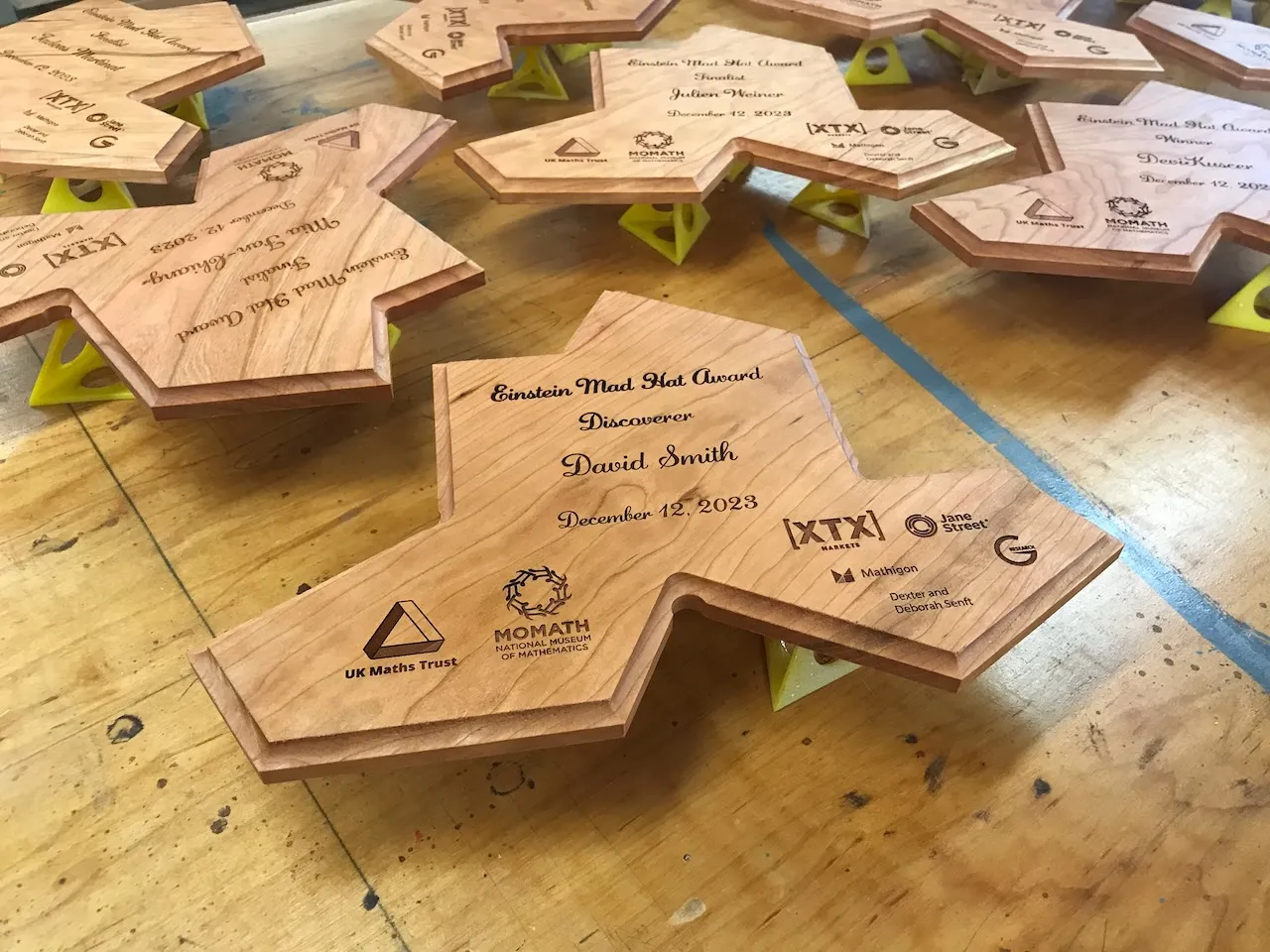
Einstein Mad Hat Award Plaques
Award plaques created for the Einstein Mad Hat Awards in 2023. The awards celebrated the discovery of the hat monotile, solving the einstein problem
Mathemalchemy
A large-scale collaborative mathematical art installation conceived by Ingrid Daubechies and Dominique Ehrmann, combining contributions from over two dozen mathematicians and artists. The installation — a richly detailed miniature world celebrating mathematics — premiered at the National Academy of Sciences in Washington, D.C. in 2022 and toured the US and internationally through 2025. Featured in the New York Times (March 2025).
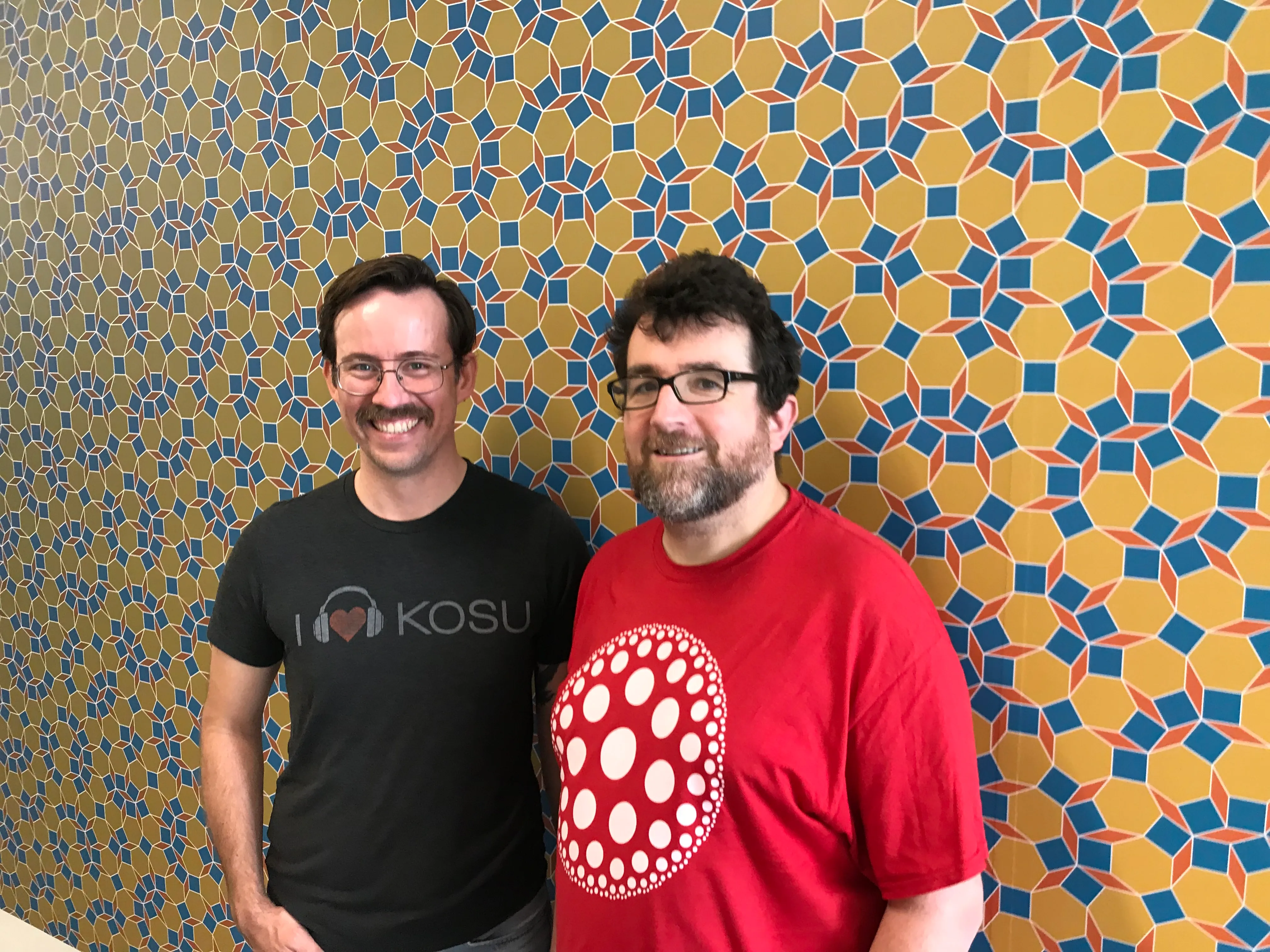
Revealing Dimensions
A 42'×8' mural installed at the Tulsa Regional STEM Alliance's Headquarters.
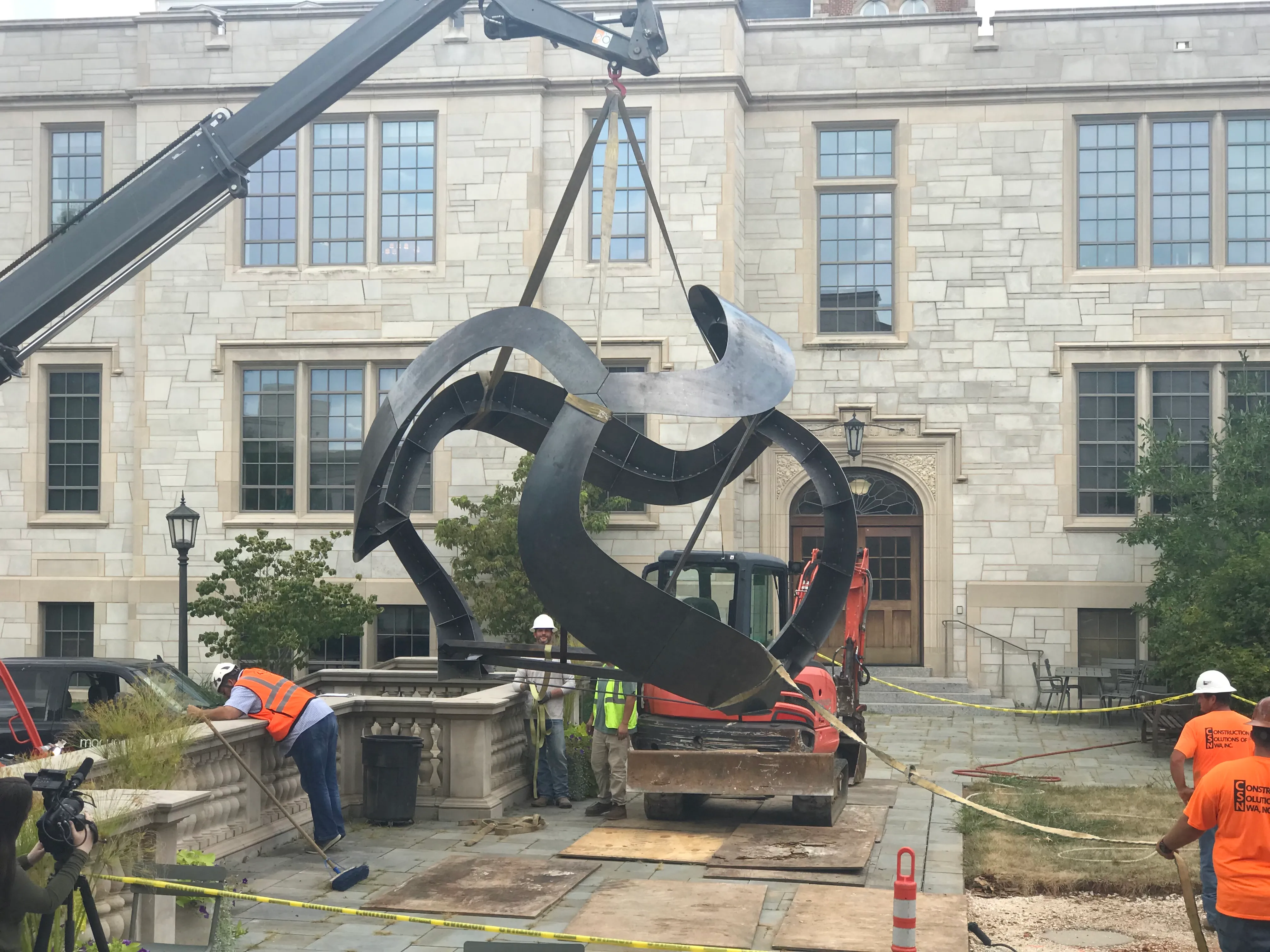
Gearhart Hall Courtyard Curvahedra
A permanent 12-foot diameter steel sculpture installed in the Gearhart Hall courtyard at the University of Arkansas. In collaboration with Emily Baker.
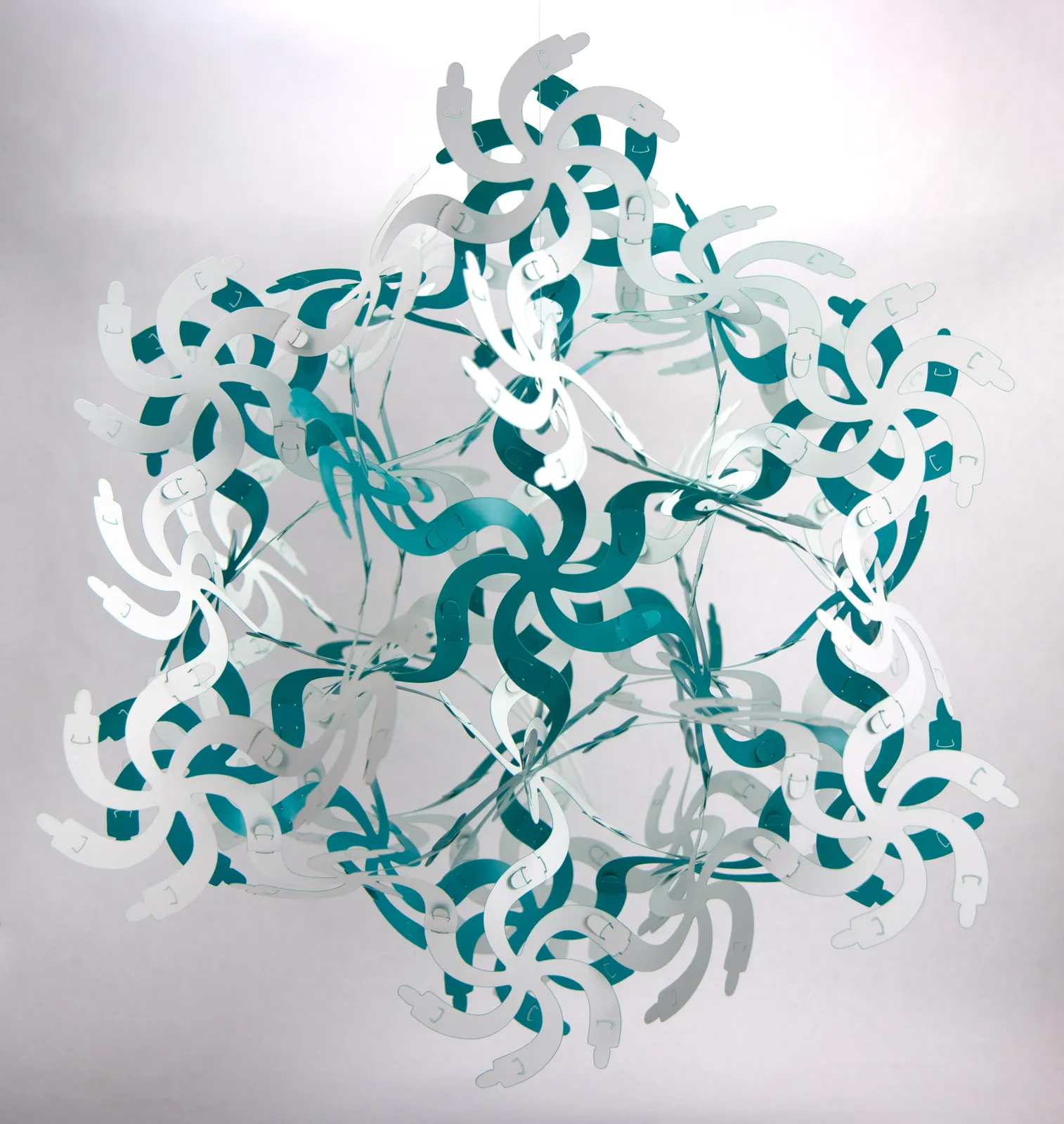
Three Triply Periodic Minimal Surfaces
Three 3D-printed models of triply periodic minimal surfaces, the Schwartz P, Schwartz D, and Gyroid surfaces.
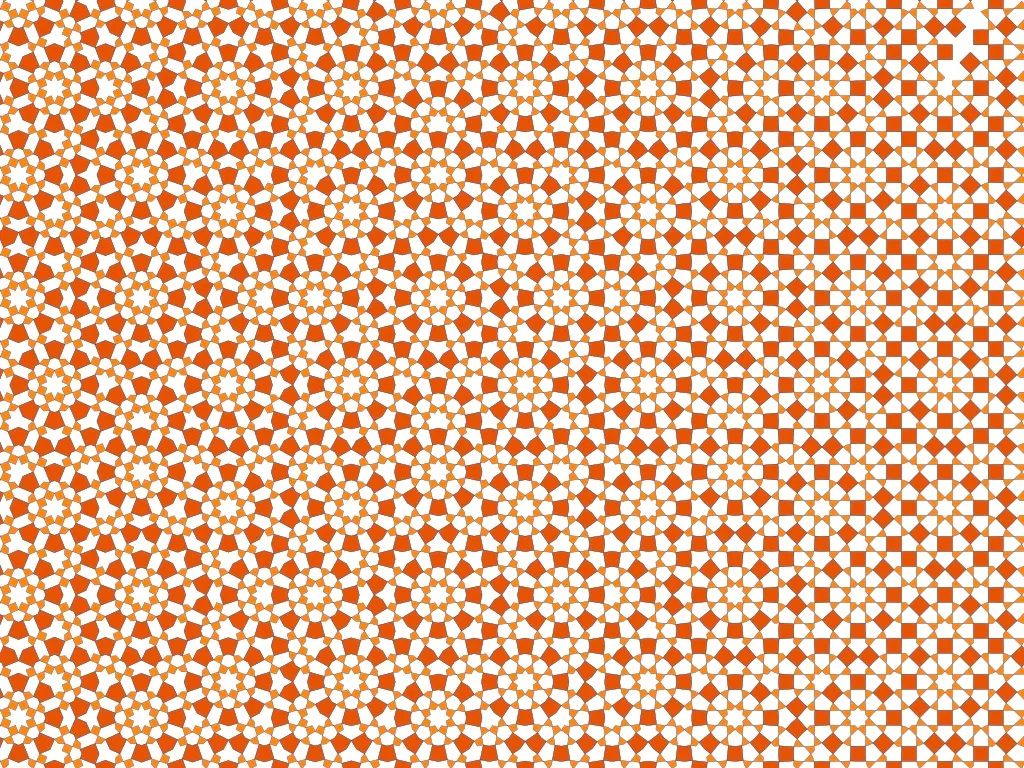
Shifting Ammann in Brightest Orange
A 52'×8' wall installation at Oklahoma State University showing an Ammann tiling pattern deforming continuously along the wall — the geometry shifts and morphs while preserving the non-periodic structure.
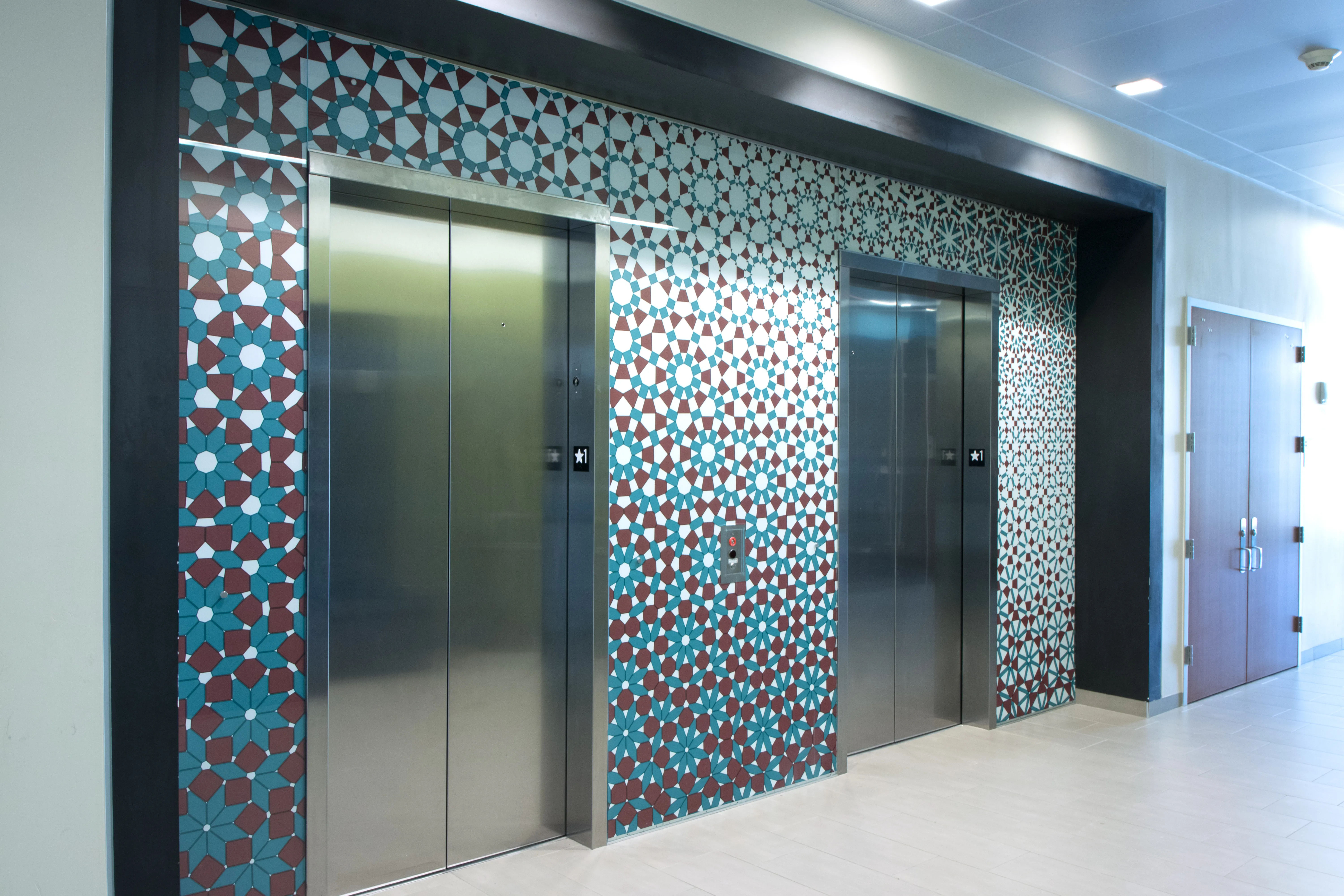
Elevator Deformations
Two dimensional parquet deformations built off non-periodic tiling patterns. They deform and transform around the elevator enclosures in Champions Hall at the University of Arkansas.

Geometry in the Walnut Grove: An Applied Mathematical Approach to Art
Paper and artwork exploring perceptualism in a mathematical art project. Joint with Carl Smith and Angela Carpenter.
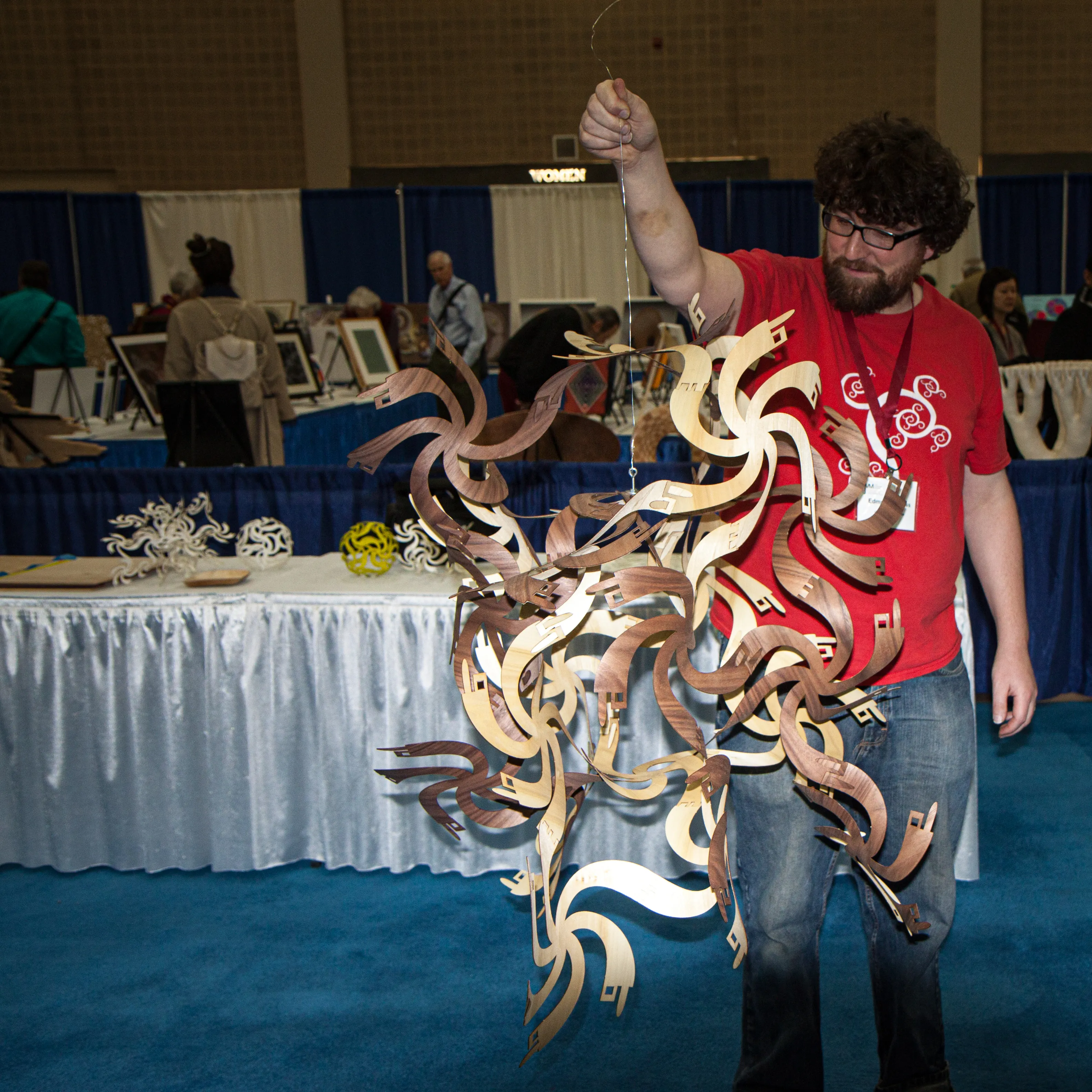
Spira-gyroid
A large-scale barn-raising at the 2015 Joint Mathematics Meetings, in which participants collaboratively assembled the Spira-gyroid — a physical model combining the geometry of a spiral with that of the gyroid minimal surface. Barn-raisings at JMM are events where mathematicians and the public build a large geometric structure together, with the assembly process itself as part of the work.
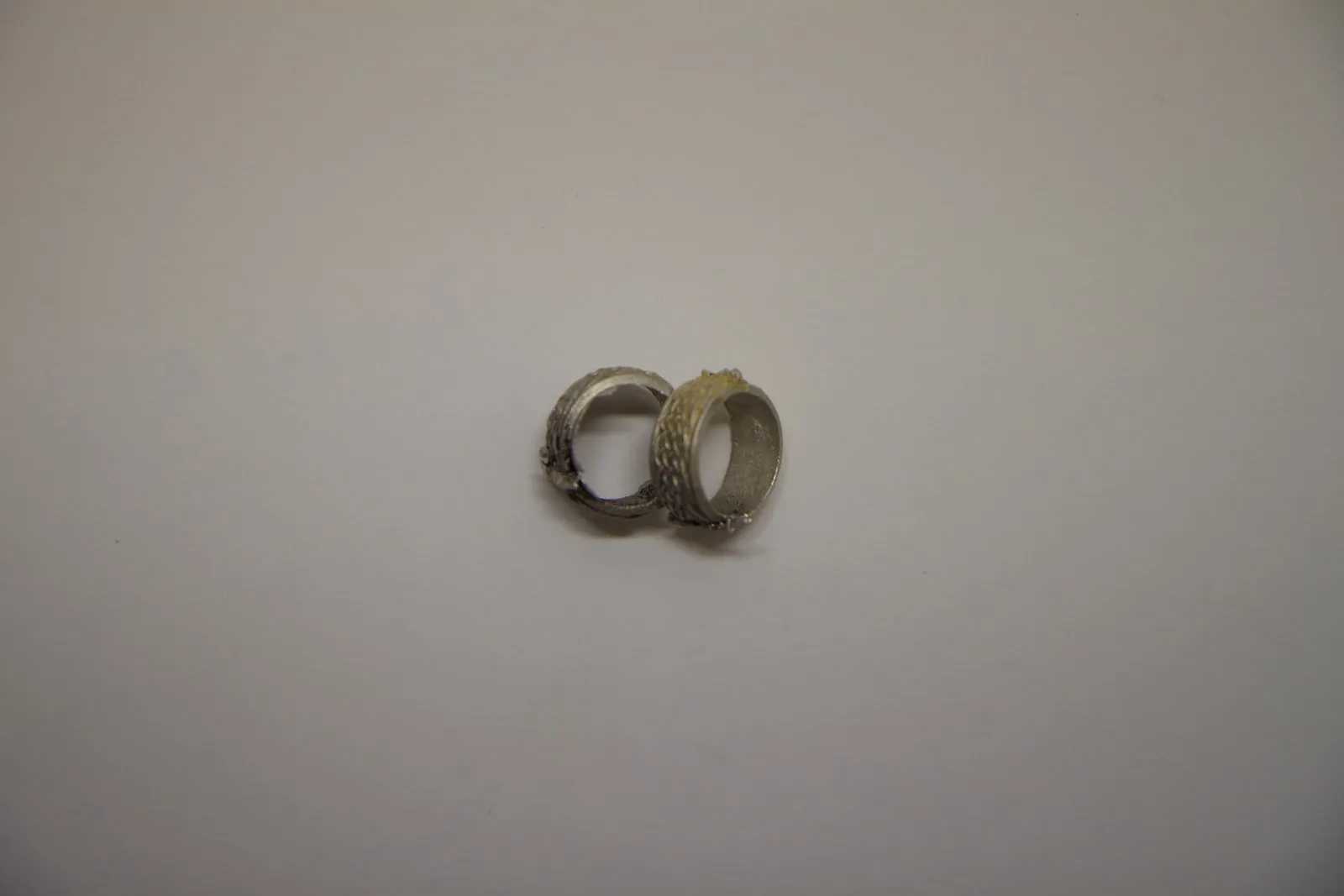
Woven Permutation Rings
Wedding rings designed using permutation theory and braid mathematics, then realised in braided copper wire and cast in silver. The weave pattern — a cyclic permutation threading each strand through every position — was selected by systematically generating and exploring all possible braid cycles in code.
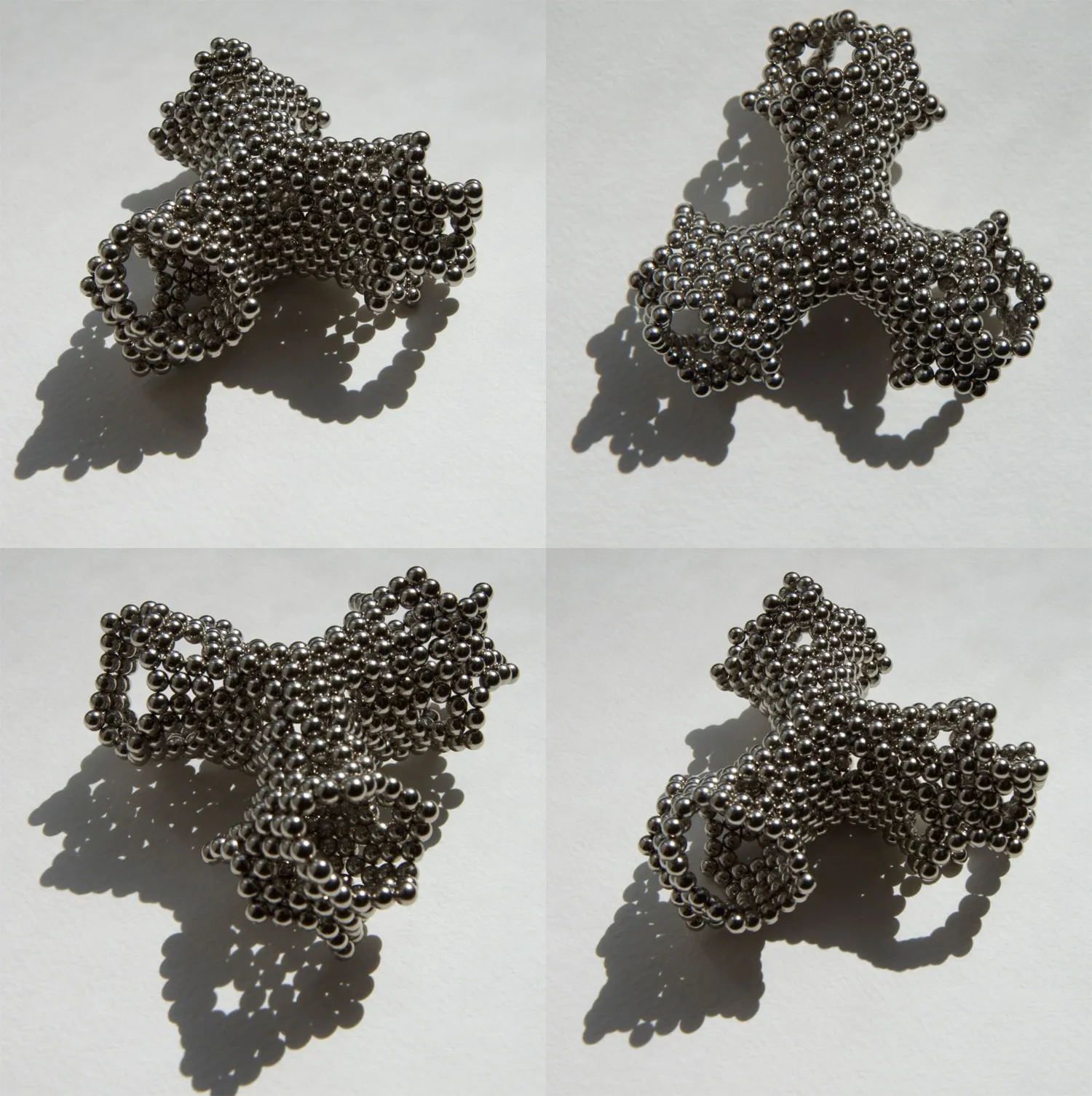
Magnetic Klein Quartic
A physical model of the Klein quartic, a genus-3 hyperbolic surface tiled by 24 regular heptagonsmbuilt from neodymium magnets.
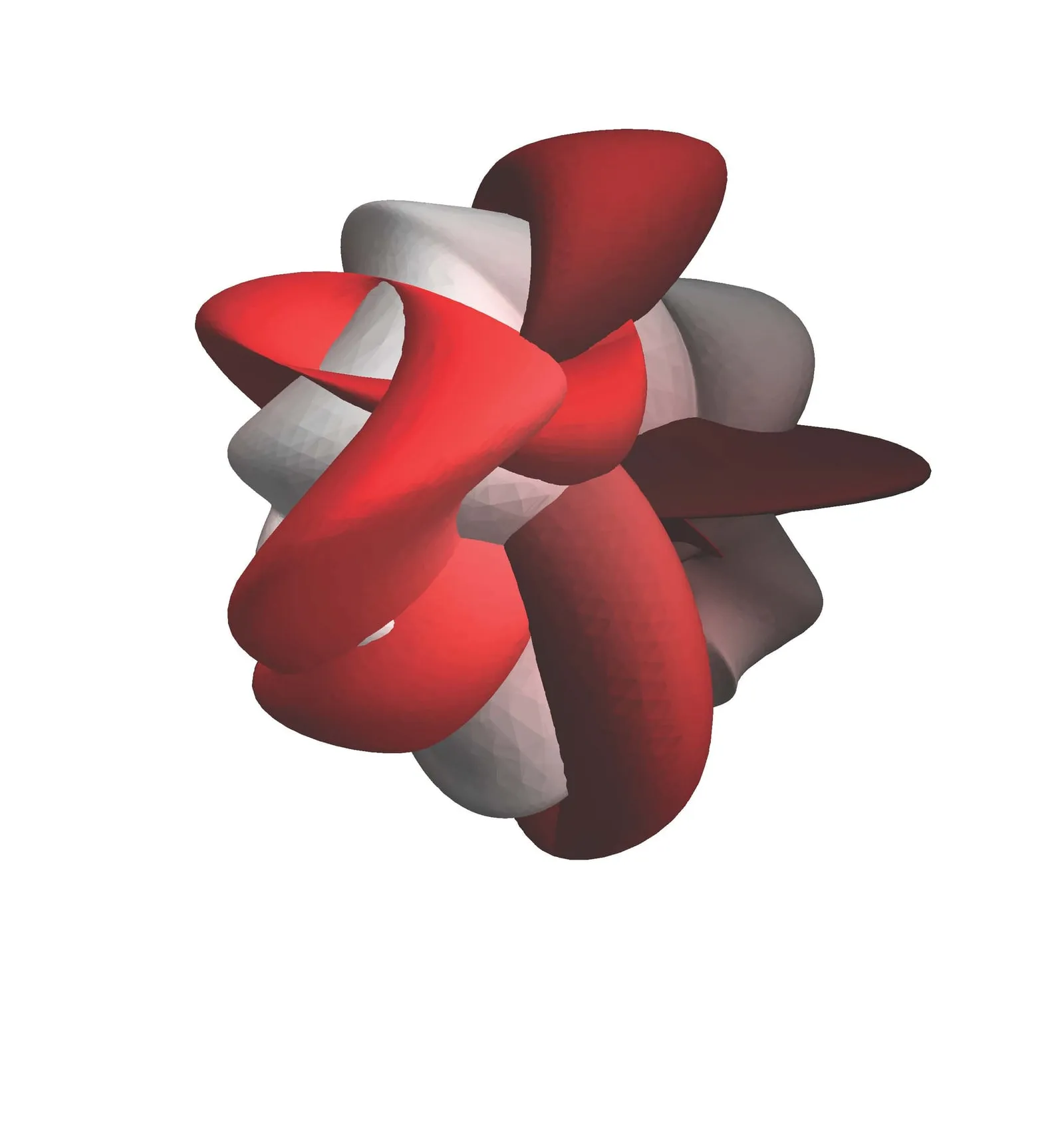
3D Spirographs
An exploration of spirograph curves extended into three dimensions, with Richard Grimes
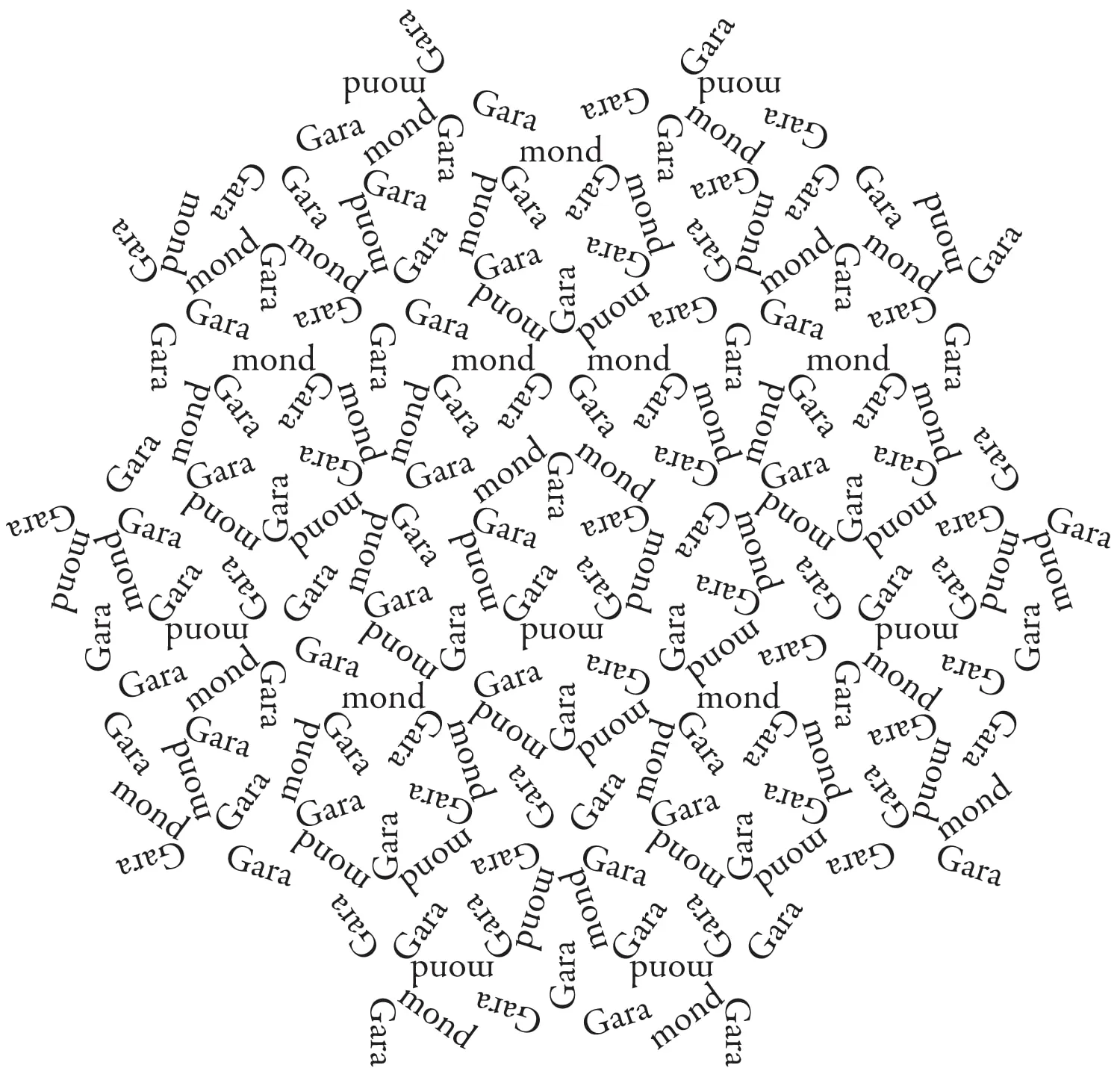
Tiling Typography
A series of four typographic studies placing classic typefaces over mathematical tiling patterns.
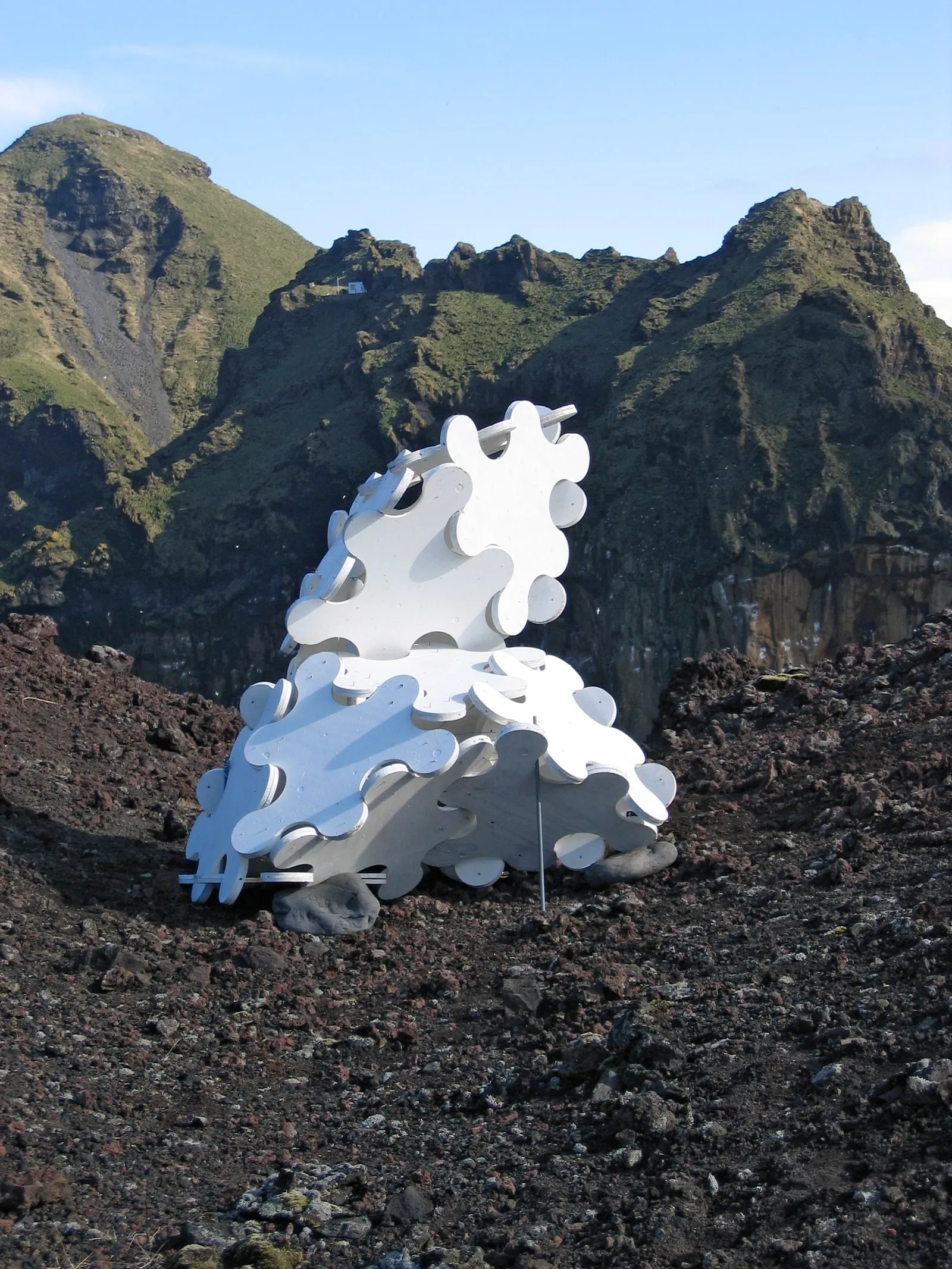
Sculpture System 5
A sculpture system of hinged triangles to make deltahedra, joint with Richard Grimes.
Curated or Solo Shows
- Creation: Between Art and Mathematics
Espace Laurent Schwartz, Institut Henri Poincaré, Paris, France — 2026-04-09 to 2026-07-25
- Warped Realities: The Art of Differential Geometry
Composite Gallery, National Museum of Mathematics (MoMath), New York, NY — 2025-08-01 to 2025-09-30
- Algebraic Starscapes — Gaukurinn Exhibition
Gaukurinn, Reykjavik, Iceland — 2020-01-01 to 2020-12-31
Group Shows
- Bridges 2025 Art Exhibition
Bridges Conference, Eindhoven, Netherlands — 2025-07-14 to 2025-07-18
- Intersections: Discover Math & Art
Mercer Island Community and Events Center, Mercer Island, WA — 2025-03-03 to 2025-04-25
- JMM 2025 Mathematical Art Exhibition
Joint Mathematics Meetings, Seattle, WA — 2025-01-08 to 2025-01-11
- JMM 2024 Mathematical Art Exhibition
Joint Mathematics Meetings, San Francisco, CA — 2024-01-03 to 2024-01-06
- Bridges 2023 Art Exhibition
Bridges Conference, Halifax, NS, Canada — 2023-07-27 to 2023-07-31
- JMM 2023 Mathematical Art Exhibition
Joint Mathematics Meetings, Boston, MA — 2023-01-04 to 2023-01-07
- Bridges 2020 Art Exhibition
Bridges Conference, Online — 2020-08-01 to 2020-08-05
- ICERM Illustrating Mathematics Exhibition
ICERM, Brown University, Providence, RI — 2019-09-16 to 2019-12-20
- JMM 2019 Mathematical Art Exhibition
Joint Mathematics Meetings, Baltimore, MD — 2019-01-16 to 2019-01-19
- Bridges 2015 Art Exhibition
Bridges Conference, Baltimore, MD — 2015-07-29 to 2015-08-02
- JMM 2015 Mathematical Art Exhibition
Joint Mathematics Meetings, San Antonio, TX — 2015-01-10 to 2015-01-13
- Bridges 2008 Art Exhibition
Bridges Conference, Leeuwarden, Netherlands — 2008-07-24 to 2008-07-29
- Bridges 2007 Art Exhibition
Bridges Conference, San Sebastián, Spain — 2007-07-24 to 2007-07-27
- Bridges 2006 Art Exhibition
Bridges Conference, London, UK — 2006-08-04 to 2006-08-09