CAMel is a lightweight, open-source CAM (Computer Aided Manufacturing) library, built as a plugin for Rhino and Grasshopper. It is the practical engine behind much of the Technology Craft work, and grows out of a simple shift in emphasis: most CAM software is designed to control the output of a machine, CAMel is designed to control the machine itself.
Numerically controlled machines, from 3-axis routers to 5-axis mills and waterjet cutters, move between states given as lists of numbers. Those states are simply positions in space, and so can be treated as geometry. Working at the level of that geometry makes it possible to find the commonalities between very different machines, to convert between the configuration spaces of specific machines and more standard representations, and to see, visualise, and edit the machine’s motion explicitly before any material is cut.
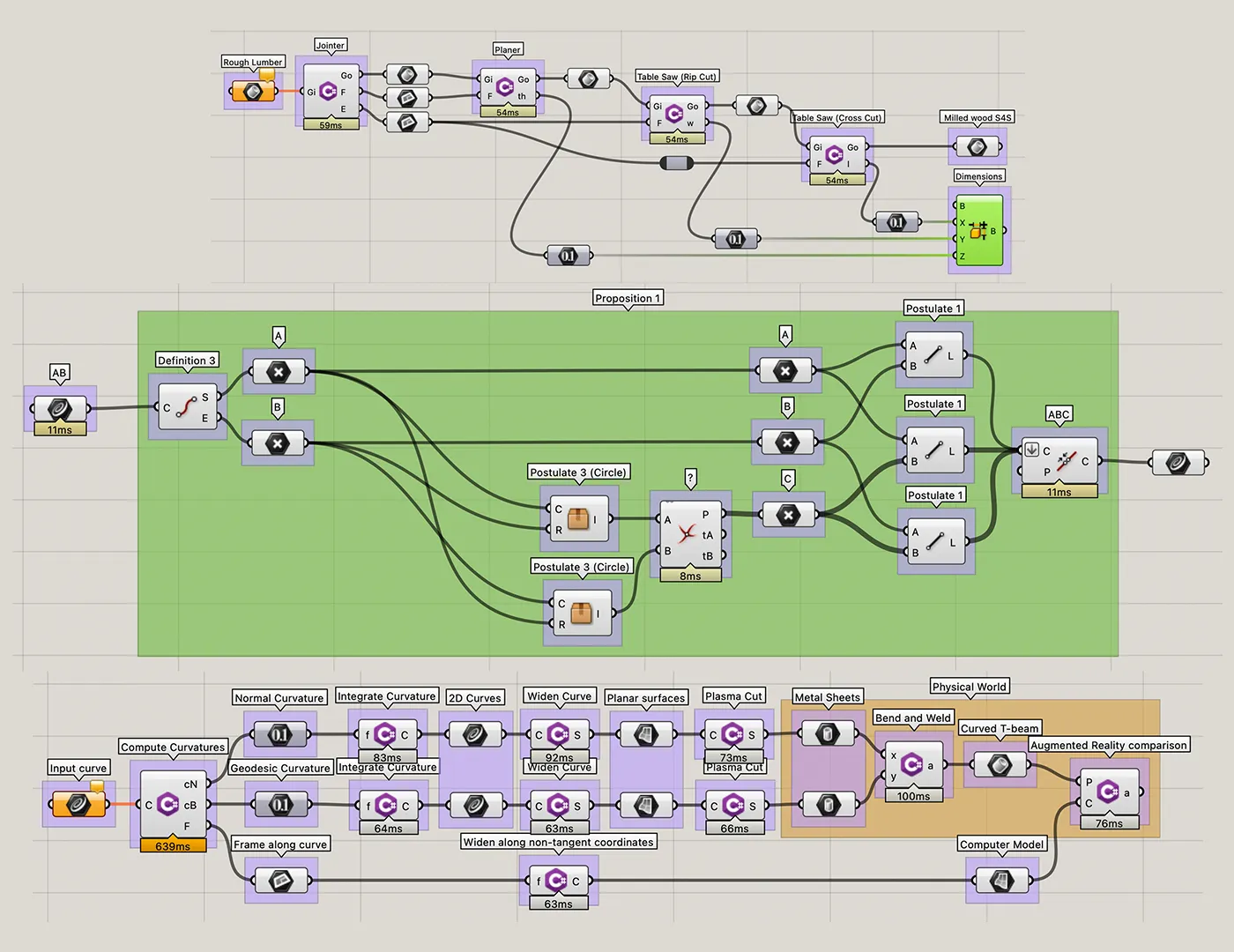
Conventional CAM is very good for production inside well-developed workflows, but that strength becomes a barrier in research, teaching, and bespoke making, where the interesting questions live in the gap between design intent and machine motion. CAMel is built for that gap. It is not so much a finished CAM tool as a set of jigs that can be quickly adapted into custom solutions, from photographing a hand-drawn line to generate a path, to cutting directly from a vector drawing, to detailing the surface of a three-dimensional form.
CAMel has been used to control 3-, 4-, and 5-axis machines, including a 5-axis OMAX waterjet cutter, and underpins the 5-axis waterjet and Zip-Form work. It is freely available and under active development.
Source and documentation: github.com/Gelada/CAMel.
I am working on a release worthy version.