Woven Permutation Rings
Wedding rings designed using permutation theory and braid mathematics, then realised in braided copper wire and cast in silver. The weave pattern — a cyclic permutation threading each strand through every position — was selected by systematically generating and exploring all possible braid cycles in code.
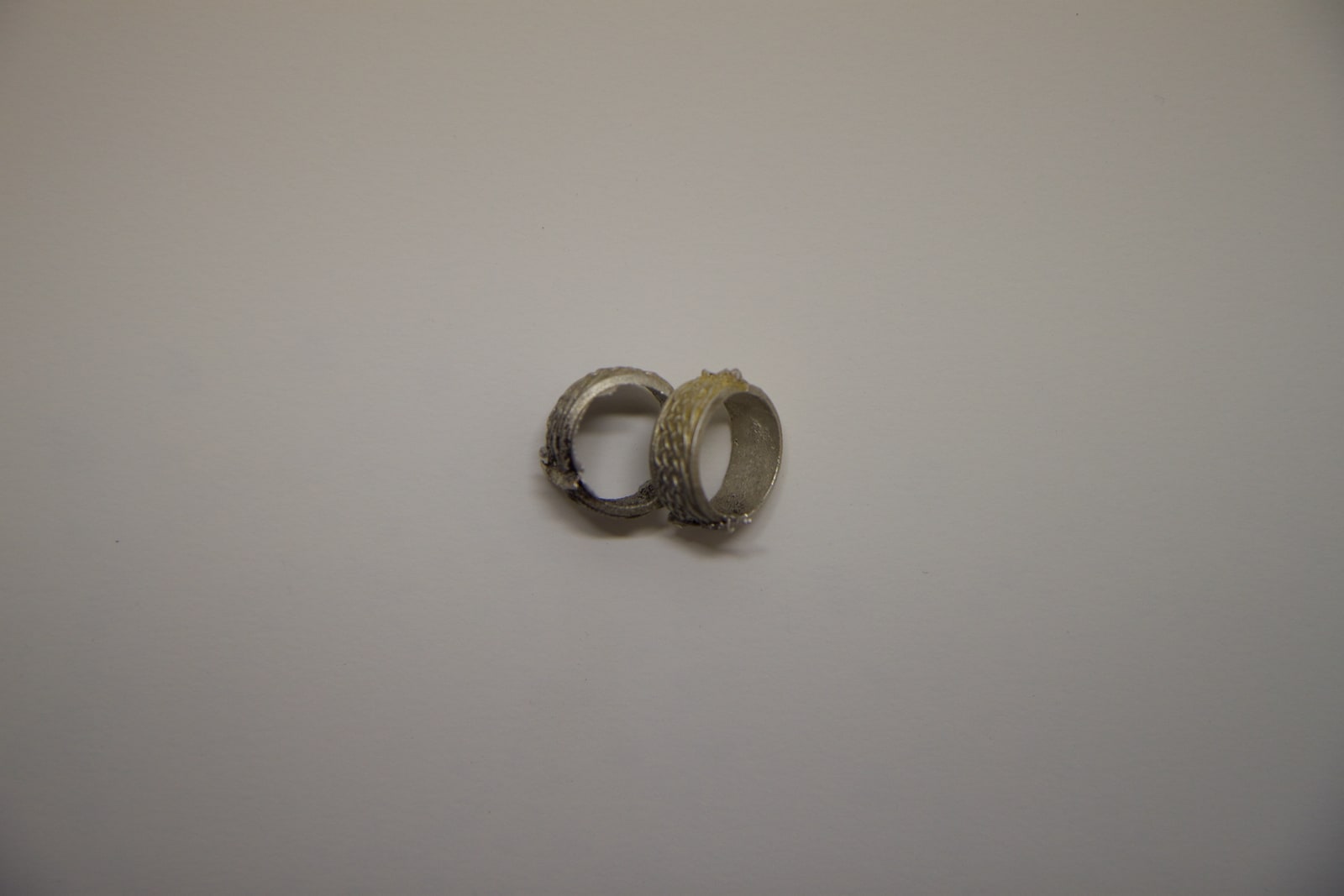
A braid is a permutation made physical: threads move through positions, and the sequence of moves determines the pattern. For a ring made of n threads, a cyclic permutation — one that sends each thread through every position before returning to the start — produces a single unified weave rather than isolated strands. The space of such cycles for a given thread count is small enough to enumerate entirely, so the design process was to generate all possibilities in code, visualise them, and select the one that read best at ring scale.
The chosen pattern was first prototyped in copper wire: strands braided by hand around a mandrel, then soldered. The prototype established the geometry and confirmed the strand count. From that blank, a mold was taken and the rings cast in silver by a jeweller, preserving the woven surface texture in metal.
The full process ran from mathematical enumeration through digital visualisation, hand braiding, moldmaking, and casting — each stage testing whether the mathematics survived translation into material form. It did.