Geometry in the Walnut Grove: An Applied Mathematical Approach to Art
Paper and artwork exploring perceptualism in a mathematical art project. Joint with Carl Smith and Angela Carpenter.
BibTeX
@article{geometry-walnut-grove,
  title   = {Geometry in the Walnut Grove: An Applied Mathematical Approach to Art},
  author  = {E. O. Harriss and C. Smith and A. Carpenter},
  journal = {Journal of Mathematics and the Arts},
  year    = {2019},
  volume  = {13},
  number  = {1-2},
  pages   = {152--172},
  doi     = {10.1080/17513472.2018.1525263},
}The paper explore a perceptualist framework for mathematical art-making in a specific place. Following Simon Bell’s aesthetics1 and Andy Goldsworthy’s practice of “shaking hands with the landscape”2, it begins with direct sensory experience, repeated visits, loose drawing, no prior agenda, before bringing in systematic thinking. Mathematics enters not as a full model but as metaphor in Yuri Manin’s sense3: an additional abstract “sense” part of the perception, not a processing of it. The specific mathematics is the projective geometry of tree grids: as a viewer moves through a regular lattice, the position and angle determines whether the grid appears dense or sparse, and looking down a lattice line produces a sharp tunnel flanked by a deep view into the structure. This analysis names and clarifies a powerful perceptual experience of the walnut grove and feeds back into the artworks design.
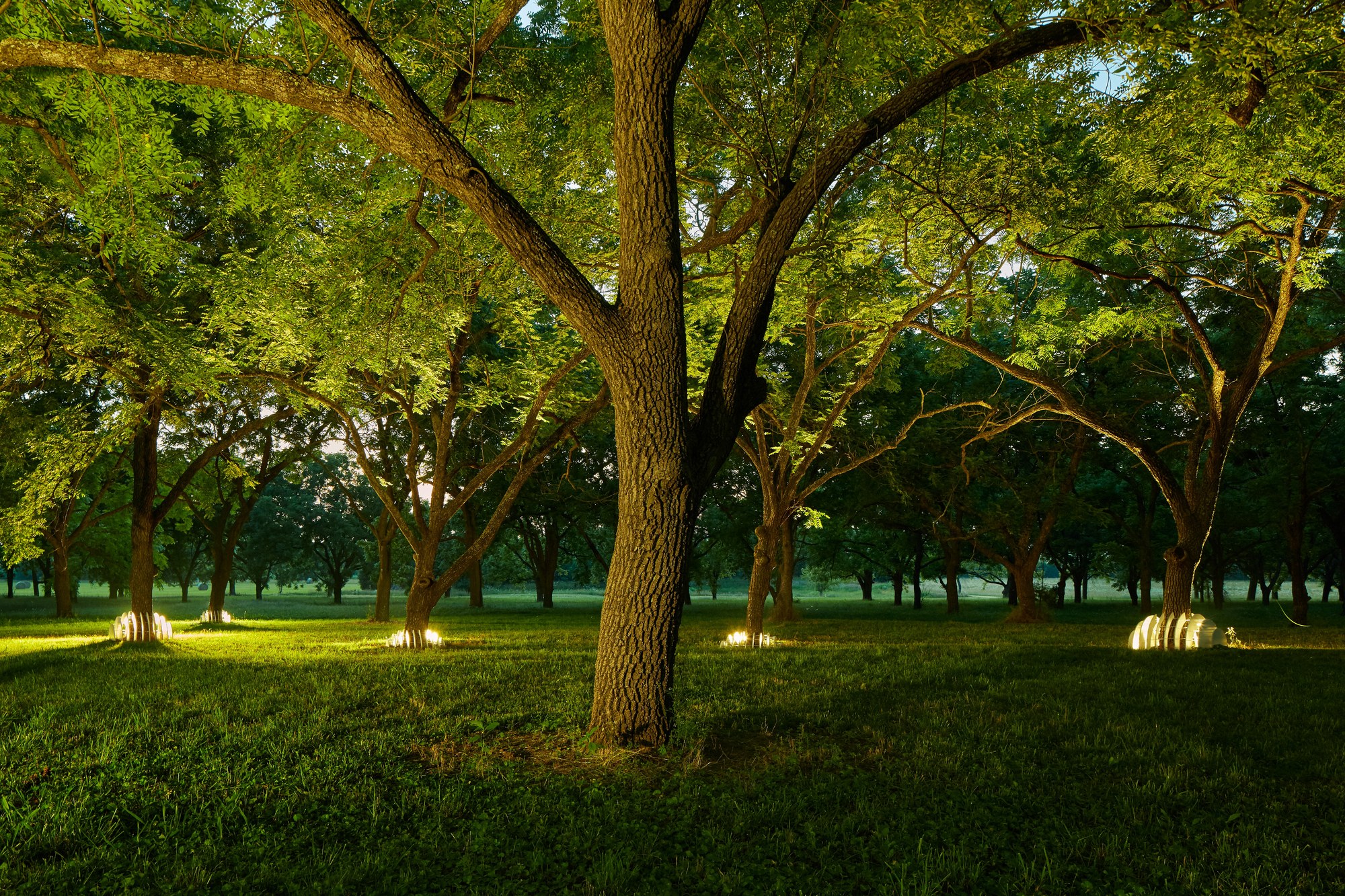
Nine slice-form ellipsoidal domes were CNC-milled from plywood and installed at the bases of nine selected walnut trees on Drake Farm in April 2016, at a community event sponsored by the Pendergraft family and the Fay Jones School of Architecture. Slice-forms are parallel planar cuts through a solid: the fins appear dense and ribbed from one angle and open to nothing from another, directly embodying the alternation between density and void that the projective geometry analysis identified in the grove. The domes elongate as they approach a central gravity tree and sink deeper into the ground. The parametric model was built in Rhino and Grasshopper; CNC cut files were generated by my CAMel software.
Later there was a photoshoot from renowned photographer Tim Hursley.
Footnotes
-
S. Bell. Landscape: Pattern, Perception and Process. 2nd ed. Routledge, London, 2012. ↩
-
T. Riedelsheimer and A. Goldsworthy. Rivers and Tides: Andy Goldsworthy Working with Time. Documentary film, 2001. ↩
-
Yu. I. Manin. Mathematics as Metaphor: Selected Essays of Yuri I. Manin. American Mathematical Society, Providence, RI, 2007. ↩