← Back
Gauss-Bonnet Sculpting
Combining curvahedra with the Gauss-Bonnet theorem to select local curvature from holonomy

BibTeX
@inproceedings{gauss-bonnet-sculpting,
  title   = {Gauss-Bonnet Sculpting},
  author  = {Edmund Harriss},
  booktitle = {Proceedings of Bridges 2020: Mathematics, Art, Music, Architecture, Education, Culture},
  year    = {2020},
  pages   = {137--144},
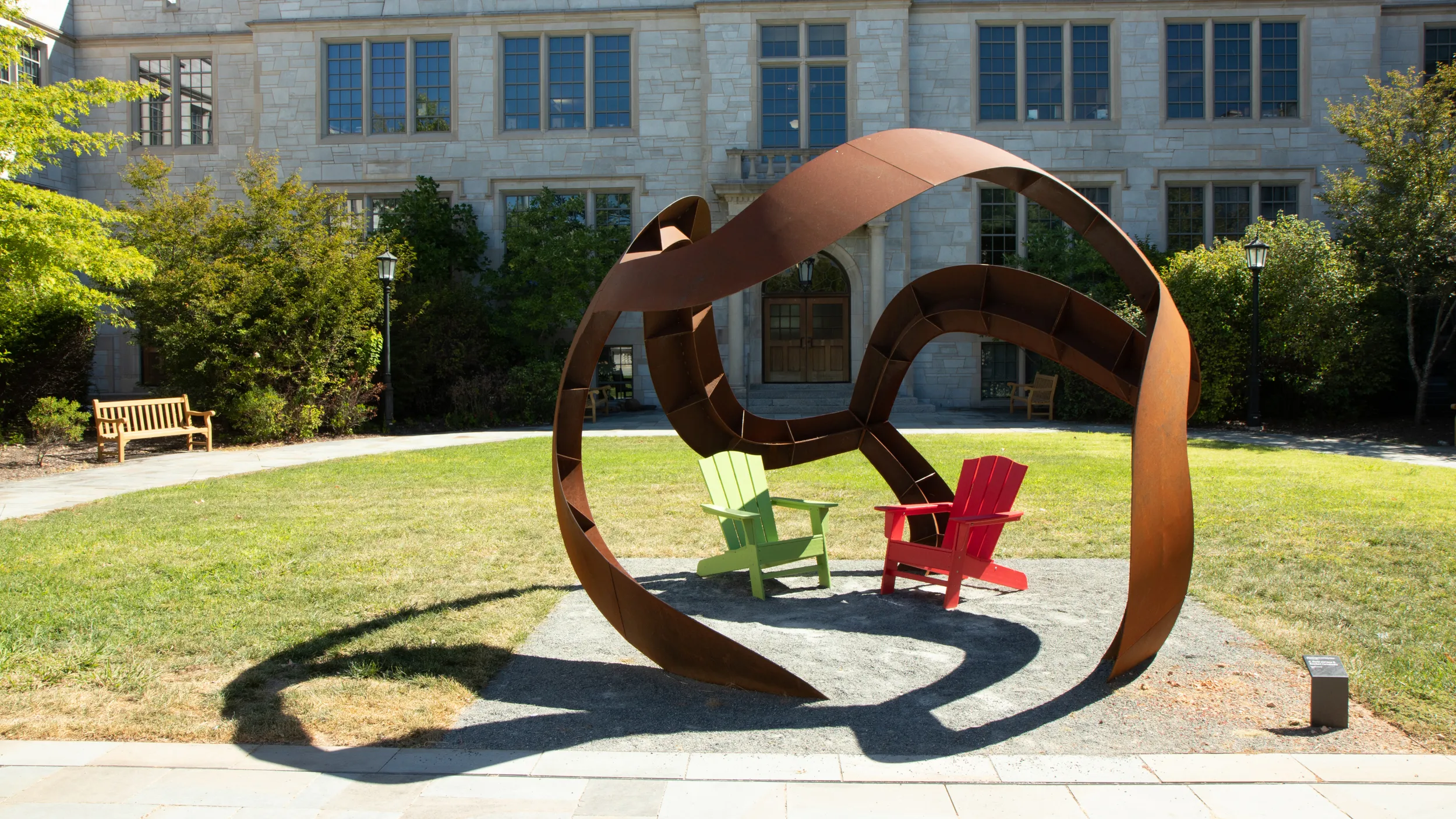
}A discretised form of the Gauss-Bonnet theorem, relating the total curvature of a polyhedral surface to the angle deficits at its vertices and the turning along its boundary, can serve as a direct design tool for sculpture. By specifying boundary loops and vertex configurations, the desired surface geometry follows from the discrete theorem as a constraint. The paper traces a progression through paper strips, Curvahedra connector pieces, and final metal works, using each medium to explore a different facet of the relationship between boundary behaviour and enclosed curvature.